The Hidden Revenue Cost of Poor AI Citation Visibility (And How to Calculate Yours)
If buyers research on ChatGPT before they book calls, a low AI citation rate quietly drains pipeline. Here is a simple formula to estimate the cost, and what moves it fastest.
Here is a calculation most B2B revenue leaders have not run yet.
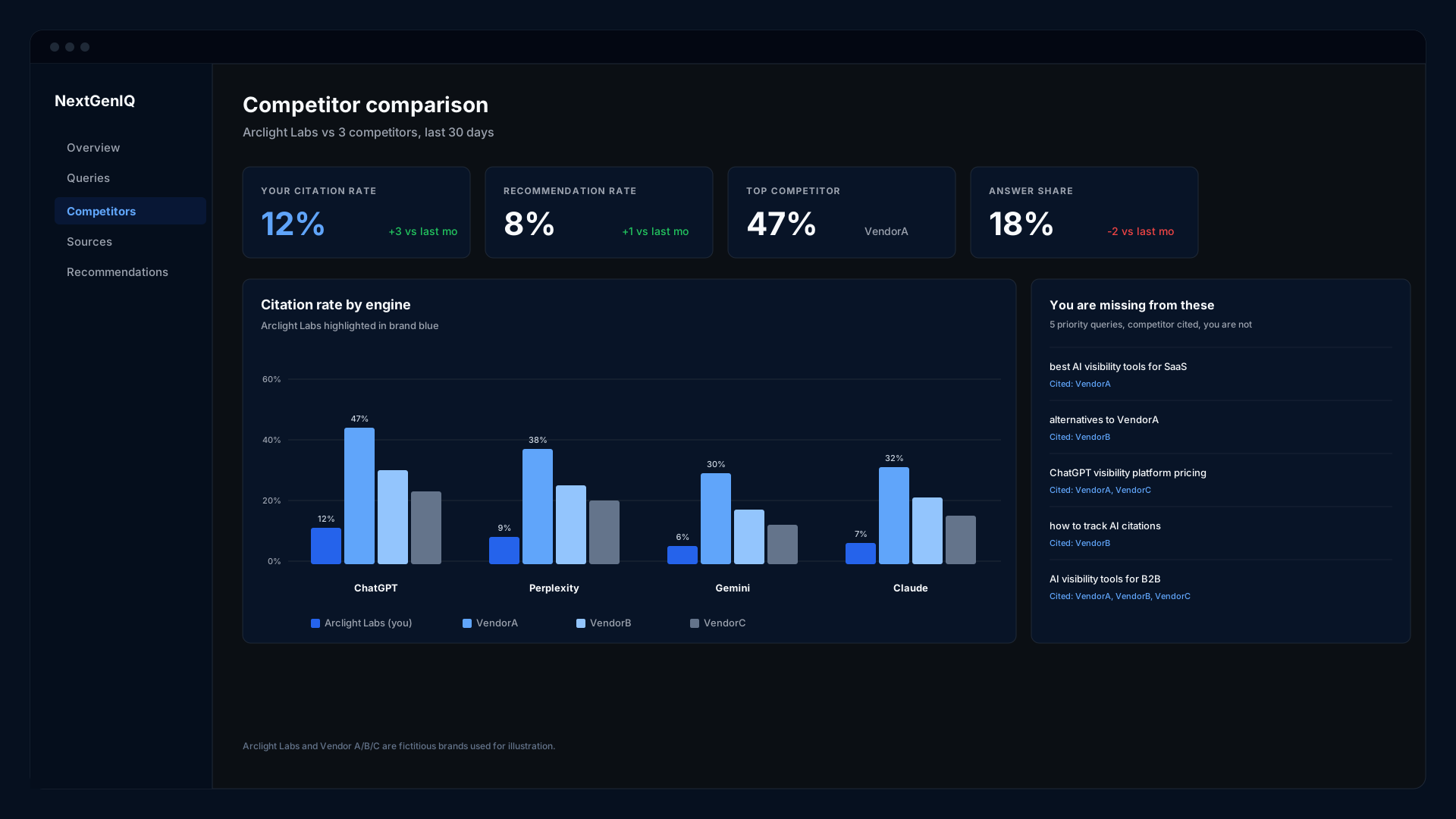
Suppose 30% of the buyers in your category now use AI tools at some point during vendor research. That is a conservative estimate for 2026; for enterprise software it is already higher. Your AI citation rate for commercial-intent queries is 8%. Your top competitor's is 54%.
If your category produces 1,000 active buyers per quarter, and AI-surfaced vendors are 3 times more likely to make the shortlist, you are losing roughly 138 shortlist slots per quarter to brands with better AI visibility. At a 20% shortlist-to-closed-won conversion and a $60,000 average contract value, that is $1.65 million in quarterly pipeline quietly moving to competitors.
The numbers will differ for your business. The pattern will not.
This post walks through where AI citations actually affect revenue, how to estimate the cost for your own category, and what changes move the number fastest.
Why this cost is hidden
Poor AI citation visibility does not show up as a single metric on any dashboard you already have. It shows up as small distortions across four places:
Paid CAC rising with no obvious cause. When your organic share of category discovery shrinks, paid has to work harder to make up the gap. Teams often attribute this to platform inflation or competitive bidding. Sometimes it is AI visibility.
Branded search flattening. If buyers hear your name less often in AI-generated answers, fewer of them type your name into Google later. Branded search is the lagging indicator.
Sales cycles lengthening. Deals that used to come in "already evaluated" now come in cold. Your AE has to re-explain the category before they can sell the product.
Win rates slipping against newer competitors. Not because the product got worse. Because the market stopped pre-qualifying your brand as one of the options.
None of these, individually, points a finger at AI visibility. Together, they do.
The four places AI citations affect revenue
1. Awareness A buyer asks ChatGPT "what tools help B2B teams track AI visibility?" If your brand is in the answer, you just acquired awareness for the cost of zero dollars. If not, a competitor did. This is the cheapest customer acquisition mechanism that has ever existed, and most B2B teams are not measuring it.
2. Category inclusion When AI answers list 3 to 5 vendors, inclusion in that list is binary. You are either in the shortlist or you are not. There is no middle ground the way there is on a search results page, where even a number-four position gets clicks.
3. Trust transfer Buyers treat AI-generated answers as mildly authoritative, even when they know better. Being named in an AI answer transfers some of that authority to your brand. Being omitted transfers it to the brands that were named.
4. Sales efficiency When your brand is pre-qualified by AI-driven discovery, your AE spends the first call on product fit rather than company credibility. The difference in win rate between "educated buyer" and "cold buyer" is typically 2 to 3 times.
A simple formula to estimate your cost
You need five inputs. Four of them you already have; the fifth takes 30 minutes to estimate.
- Quarterly buyers in your category (B). Use your TAM or serviceable market estimate.
- AI research share (R). What percent of buyers use AI tools during vendor research. Start at 30% if you do not know; that is the 2026 baseline for most B2B software.
- Your AI citation rate (C). Run 20 commercial-intent queries across ChatGPT, Perplexity, Gemini, and Claude. Count how many mention your brand. Divide by 80 (20 queries times 4 engines).
- Shortlist multiplier (M). AI-cited brands are shortlisted roughly 2 to 3 times more often. Use 2.5 conservatively.
- Average contract value (ACV) and close rate (W) from your own data.
Estimated quarterly revenue at risk:
B × R × (M - 1) × (top_competitor_C - your_C) × W × ACV
If the answer is bigger than your marketing team's quarterly budget, AI visibility is no longer a content problem. It is a revenue priority.
What moves the number fastest
Three actions, in order of speed:
Fix your entity first (2 to 4 weeks). Rewrite your homepage, solution pages, and about page so they state clearly what category you serve and what outcome you deliver. AI engines cannot cite what they cannot classify. This single change moves citation rates more than most teams expect.
Publish answer-shaped content (4 to 8 weeks). Comparison pages, alternatives pages, pricing pages, and use-case pages. Not awareness-stage blog posts. AI engines cite content that directly answers the buyer's literal question.
Earn two external mentions per quarter (ongoing). One Substack, one podcast, one Reddit thread, one analyst inclusion. Not paid listicles. AI engines weight source diversity, and a handful of trusted third-party citations often outperforms a dozen new pages on your own domain.
Structured data, internal linking, and technical SEO are also inputs, but they are amplifiers. They make the first three work faster. They do not replace them.
The honest version of "measure what matters"
Most marketing dashboards were built for a search world where rankings and clicks told the full story. Those days are over.
If you are not measuring AI citation rate for commercial-intent queries, quarterly, by engine, against your top three competitors, you are managing a funnel with one of its biggest inputs blindfolded.
You do not need a platform to start. You need 20 queries, a spreadsheet, and an hour.
After that, if you want the measurement automated, benchmarked against competitors, and tied to specific content actions, that is what NextGenIQ was built for.
Run a free competitor comparison audit to see your AI citation rate against your top competitors across all four major AI engines. Free, 60 seconds, no credit card.
See what ChatGPT says about your brand.
NextGenIQ runs your real buyer prompts across ChatGPT, Perplexity, Gemini, and Claude. Get your AI visibility score in 60 seconds.
Check Your AI Visibility for Free