How to Choose an AI Visibility Platform: A B2B Marketer's Buyer's Guide
The AI visibility tool market is six months old and crowded with lookalikes. Here is what actually matters, what to ignore, and the questions to ask every vendor.
The AI visibility category is roughly 18 months old. There are already more than 30 vendors. Most of them ship the same dashboard with a different logo.
If you are responsible for choosing one, the real work is filtering out the lookalikes before you start demos.
This guide walks through the non-negotiable capabilities, the common red flags, and the 12 questions that separate serious platforms from pretty dashboards.
The three things every platform claims to do
Before we get into what matters, here is what every vendor in this space will say on their homepage:
- "We track your brand across ChatGPT, Perplexity, Gemini, and Claude."
- "We benchmark you against competitors."
- "We recommend actions to improve your visibility."
Those claims are now table stakes. A platform that cannot do all three is not worth a demo. A platform that only does those three is a dashboard, not a platform.
The real differentiators are below.
Non-negotiable capabilities (walk away if missing)
1. Per-engine breakdown, not averaged scores.
Your performance in ChatGPT is often materially different from Perplexity. One may weight your content heavily; another may prefer Reddit and news. A platform that hides this behind a single blended score is useless for planning. You need to see each engine separately, with the ability to filter.
2. Commercial-intent query isolation.
Total citation count is the wrong number. The right number is citation rate on commercial-intent queries, because that is the subset tied to pipeline. If a platform cannot segment by query intent, you will be optimizing for volume instead of revenue.
3. Competitor benchmarking at the query level.
"You are cited in 12% of answers, competitor is cited in 34%" is less useful than "on the 8 specific queries where your competitor is cited and you are not, here is why." You need query-level competitor data, not just aggregate comparisons.
4. Source attribution.
When your brand is cited, which source did the engine pull from? Your domain? A Reddit thread? An analyst report? This tells you where your visibility is coming from and where to invest in more of it. Platforms that do not surface source URLs cannot help you make the next decision.
5. Change detection over time.
You need to know what moved this week, not just a snapshot. If your recommendation rate on a priority query drops, you want to know within 7 days, not at the end of the month. Ideally, the platform tells you what changed on the content side, the competitor side, or the model side that correlates with the movement.
6. Exportable data.
Your data should be exportable in CSV or via API. If a vendor locks your visibility data inside their dashboard, you cannot integrate it into your own reporting, and you are trapped the moment you want to switch.
Highly valuable capabilities (strong preference)
Action recommendations tied to gaps.
Good platforms tell you not just where you are losing, but what to do. "Your homepage hero is unclear on category" or "Three competitors have alternatives pages, you do not" is dramatically more actionable than "Your citation rate is below average." This is the feature most platforms still do poorly.
Content change attribution.
If you publish a new page, can the platform tell you whether it moved the needle for specific queries within 30 days? Closing this feedback loop is what separates experiments from strategy.
Historical data depth.
For seasonal categories or long sales cycles, you need at least 6 months of history to see real patterns. A platform that only shows you the last 30 days is a trailing indicator, not a planning tool.
Prompt customization.
Generic prompt sets miss what matters in your category. The ability to define your own 25 to 50 priority queries, by buyer persona and funnel stage, is the difference between a platform that reports on you and a platform that reports on your pipeline.
Multi-language and multi-region.
If you sell in more than one market, AI visibility is not uniform. Your citation rate in US English queries may be 40%; in Spanish, 3%. Platforms that only track one region will hide material gaps.
Red flags to walk away from
Red flag 1: No methodology transparency.
If a platform will not tell you how often it runs queries, how it handles model updates, or how it scores recommendations, you are buying a black box. Ask specifically. If the answer is vague, leave.
Red flag 2: "Proprietary AI visibility score" with no breakdown.
A single composite score makes for a compelling sales deck and a useless operating tool. You need the inputs, not just the output. Any platform selling "our AI score is patent-pending" without showing you the components is trading credibility for mystique.
Red flag 3: Flat pricing regardless of query volume.
AI visibility monitoring is expensive to run. Each prompt, through each engine, costs real API money. A platform charging $99/month for unlimited queries across four engines is either losing money, running queries so rarely the data is stale, or sampling tiny cohorts and extrapolating. Pricing should scale with monitoring depth.
Red flag 4: No competitor data.
Some platforms show you your own metrics but hide competitors behind higher tiers, or skip them entirely. Visibility without benchmarking is a vanity metric. You need to see the gap to know what to fix.
Red flag 5: Agency reselling, not a product.
Several "platforms" on the market are thin dashboards on top of a services engagement. That is not necessarily bad, but price and scope it correctly. You are buying an agency, not software. Ask directly: is this a self-serve product or a services contract with a dashboard?
Red flag 6: Founding story with no AI visibility data before 2025.
Teams that pivoted from generic SEO to AI visibility in the last 12 months often port over SEO frameworks that do not translate. Ask to see a team member or advisor with specific LLM or retrieval-augmented generation expertise. The model side matters, not just the marketing side.
12 questions to ask every vendor
Hand these to the vendor before the first call. The quality of the answers tells you more than the demo.
- How often do you run each prompt through each engine?
- Do you use the logged-out, memory-off state for each engine, and how do you verify this?
- Can I define my own 25 priority prompts? Is there a limit?
- Can I segment by query intent (category, comparison, use-case)?
- Do you surface source URLs for each citation, and can I filter queries by source?
- What is your methodology for detecting week-over-week change, and how do you separate real change from model variance?
- How do you benchmark competitors? Do I get query-level competitor data or aggregate only?
- Can I export all raw data (CSV and API)?
- How do you handle model updates (e.g., when OpenAI ships a new version of GPT)?
- Do you offer multi-language and multi-region monitoring? At what tier?
- What specific content actions do you recommend, and how do you attribute results to those actions?
- Who are three customers I can reference, ideally in my category?
If a vendor cannot answer at least 10 of these 12 clearly, they are not ready for a serious B2B buyer.
A simple scoring framework
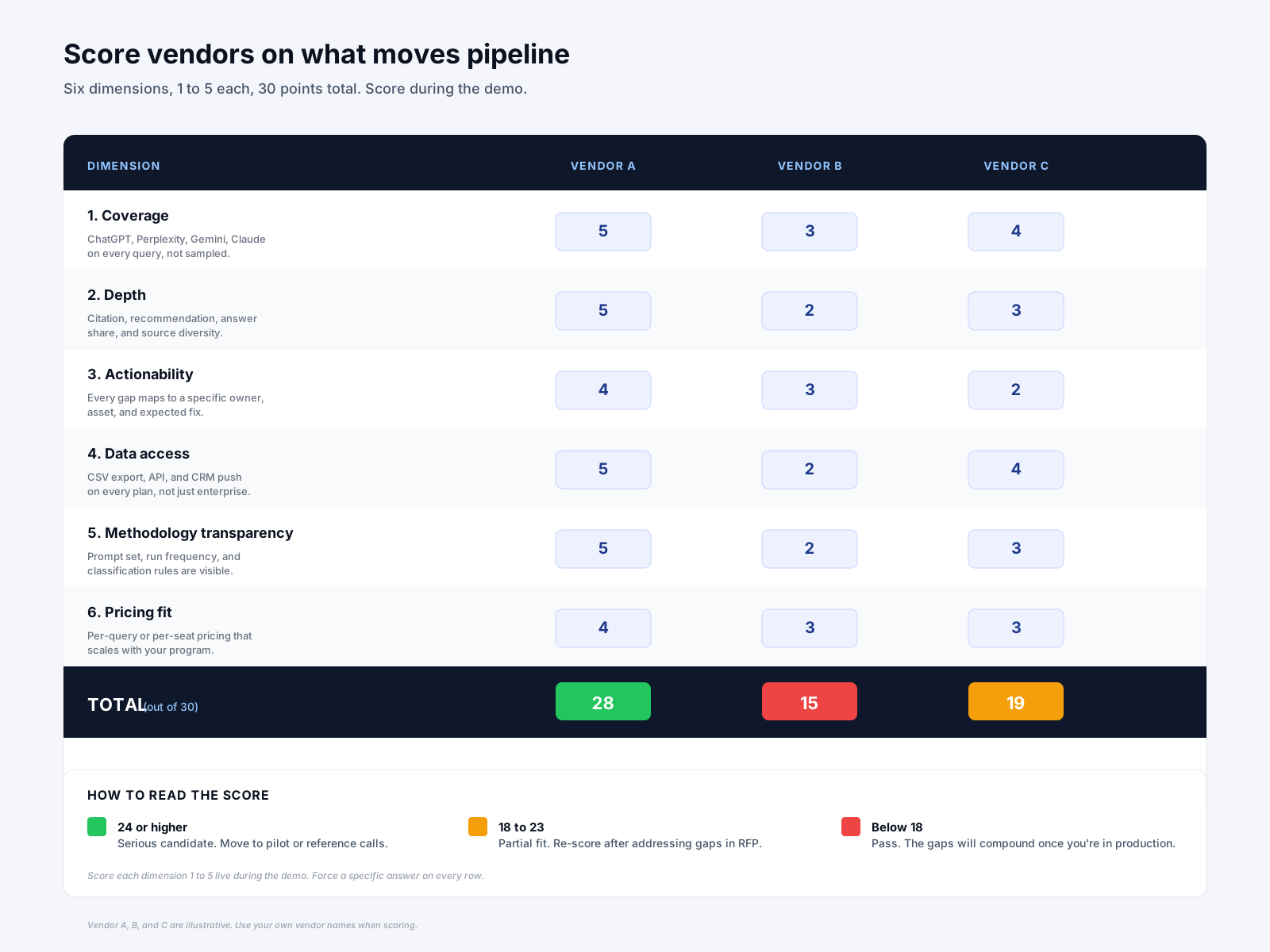
Use this to compare the platforms on your shortlist. Score each one from 1 to 5 on these six dimensions:
- Coverage: All four major engines? Multi-region?
- Depth: Query-level data? Source attribution? Competitor detail?
- Actionability: Specific recommendations tied to gaps?
- Data access: Export, API, integrations?
- Methodology transparency: Clear, documented, auditable?
- Pricing fit: Scales sensibly with your monitoring volume?
A platform that scores 24+ out of 30 is a serious candidate. Below 18 is a pass.
What a platform actually buys you
A serious platform is not a spreadsheet replacement. It delivers four things no analyst can reproduce by hand:
- Automation and change alerts you do not have to build or maintain
- Query-level competitor data at a depth and frequency manual work cannot match
- Time to value measured in hours, not quarters
- A shared source of truth your content, SEO, and GTM teams all work from
Most B2B teams need this the moment they are tracking more than 15 prompts and more than 2 competitors, which is basically everyone serious about the discipline.
The bottom line
The AI visibility platform market is still young enough that most vendors look the same. The ones worth your budget are transparent about methodology, surface query-level competitor and source data, make recommendations you can actually act on, and charge pricing that scales with what monitoring honestly costs.
If you are evaluating vendors right now, use the 12 questions, score them on the six dimensions, and shortlist anyone scoring 24+.
For a direct comparison against the tools on your list, NextGenIQ gives you per-engine, per-query, per-competitor data across ChatGPT, Perplexity, Gemini, and Claude, with source attribution and action recommendations tied to pipeline impact.
Start with a free audit to see what a real competitor benchmark looks like in 60 seconds, then compare it to anything else on your shortlist. No credit card, no sales call required.
See what ChatGPT says about your brand.
NextGenIQ runs your real buyer prompts across ChatGPT, Perplexity, Gemini, and Claude. Get your AI visibility score in 60 seconds.
Check Your AI Visibility for Free