AI Visibility vs SEO: What Changes, What Stays, and Where Most B2B Teams Get It Wrong
SEO is not dying. But AI visibility is not the same discipline. Here is a side-by-side breakdown of where they overlap, where they diverge, and what B2B marketers should do about it.
SEO is not dying. Anyone telling you otherwise is selling you something.
But if your marketing team is optimizing only for traditional search rankings in 2026, you are going to lose the next five years of B2B demand. Here is why, and what to do about it.
The short version
SEO helps you get found in search results. AI visibility helps you get included in answers. These are different jobs, with different inputs, different metrics, and different time horizons. They share a foundation, but they are not the same discipline.
The B2B teams that keep treating them as one thing, or pick one over the other, are the ones most likely to underperform for the next 18 months.
Where they actually differ
| SEO (traditional) | AI visibility | |
|---|---|---|
| Goal | Rank on a results page | Be included in a generated answer |
| Success metric | Position 1 to 10, clicks, CTR | Citation rate, recommendation rate |
| Buyer action | Chooses which link to click | Accepts a pre-filtered shortlist |
| What's rewarded | Keyword match, backlinks, freshness | Entity clarity, source trust, answer-shaped content |
| Unit of content | Pages that rank | Sentences and facts that get quoted |
| Time to move | 3 to 9 months | 2 to 8 weeks |
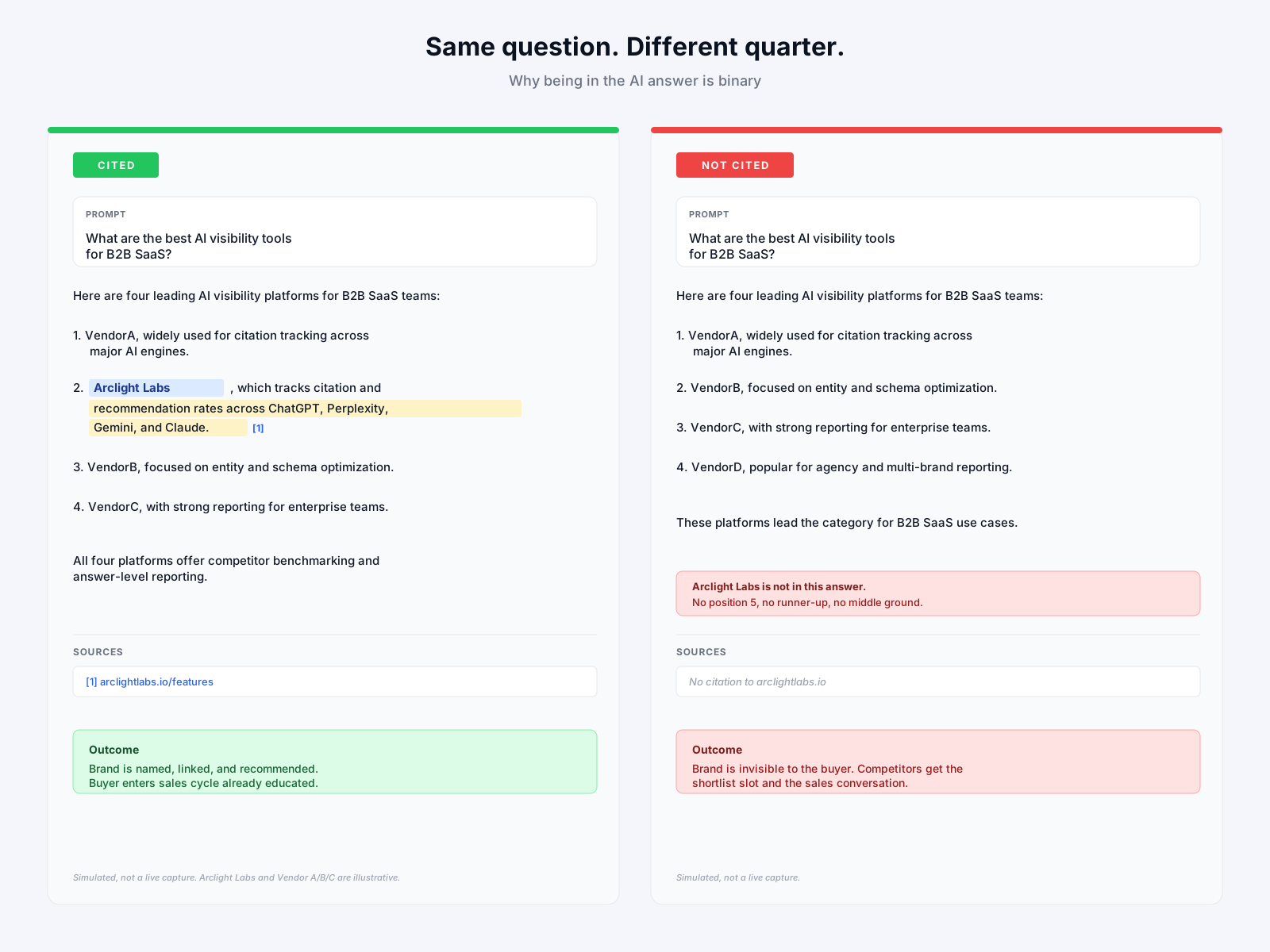
| Competitive dynamic | Gradient (position 1 to 10) | Binary (in the answer or not) |
| Measurement | Rank trackers, Search Console | Manual audits, AI visibility platforms |
The binary part is the one most SEO teams underestimate. On a search results page, ranking number 4 still gets clicks. In an AI answer, position 4 on the shortlist still gets named. Position 6 does not exist.
Where they overlap (and you still need both)
AI engines are trained on and retrieve from the web. Most of them still weight:
- Page authority and link profile
- Content depth and topical authority
- Technical health and crawlability
- Structured data and clean markup
- Freshness and update cadence
If your SEO foundation is broken, your AI visibility will also be broken. You cannot skip the fundamentals and expect AI engines to find you.
This is why "AI visibility is replacing SEO" is wrong. It is stacking on top of SEO.
Where they diverge (and where most teams get it wrong)
Content requirements are different.
SEO rewards pages that target a keyword. AI visibility rewards content that answers a question in a way the model can quote.
Practically, this changes three things:
-
Structure: AI engines cite short, declarative sentences. Paragraphs packed with qualifiers and brand voice rarely get pulled. Your content needs to include "quotable moments" - direct statements of fact a model can extract.
-
Specificity: Generic listicles rank fine in Google. AI engines prefer content with specific numbers, named examples, and clear categorization. "7 tools for X" with named vendors beats "tools that help with X" nearly every time.
-
Intent coverage: Traditional SEO thinks in keywords. AI visibility thinks in questions. A single keyword maps to dozens of possible questions; you need content that covers the question space, not just the keyword.
Source trust works differently.
Google weights backlinks. AI engines weight something closer to "how often this entity is mentioned in trusted contexts across the web." A link from a mid-tier domain and a mention in a trusted newsletter are counted differently. The newsletter often counts for more.
This means off-site authority work for AI visibility looks less like traditional link building and more like analyst relations, community presence, and podcast circuits.
Metrics are different.
SEO tracks rankings, clicks, and organic conversions. AI visibility tracks:
- Citation rate: share of answers where your URL is linked
- Recommendation rate: share of commercial-intent answers where your brand is named
- Answer share: of the brands named in an answer, what percent are yours
- Source diversity: how many distinct domains cite you
Most teams running an SEO-only dashboard will never see these numbers, because they do not exist in Search Console.
Where most B2B teams are getting this wrong right now
Mistake 1: Treating AI visibility as "just more SEO." Teams produce the same content they have always produced and assume it will also work for AI. It partially will, but the easy wins (answer-shaped content, comparison pages, entity clarity) get left on the table.
Mistake 2: Abandoning SEO for "GEO." The opposite mistake. Some teams are pulling back on traditional SEO investment because they think AI search is replacing Google. Google is not going anywhere in B2B discovery for a long time, and the foundation it gives you is exactly what AI engines reward.
Mistake 3: Measuring only mention count. Early AI visibility tools focus on counting how often a brand is mentioned. Total mentions in informational queries does not correlate with pipeline. Mentions in commercial-intent queries do. Most teams track the wrong number.
Mistake 4: Running them in separate silos. The content team optimizes for SEO. Someone else, or no one, owns AI visibility. The two disciplines share 70% of the same inputs. Separating them duplicates work and misses compounding wins.
The integrated playbook
If you are building a modern B2B organic strategy, this is the structure that works:
-
Foundation layer (SEO fundamentals): technical health, schema, core page coverage, backlink profile. Non-negotiable.
-
Content layer (dual-purpose): every major piece of content should both rank for a keyword and be quotable by an AI engine. Shorter sentences, named examples, clear structure, specific numbers. This costs no more to produce than generic content once the team retrains.
-
Category-authority layer (AI-specific): comparison pages, alternatives pages, buyer's guides, pricing pages. These over-index on AI visibility because they answer commercial-intent questions directly.
-
Source diversity layer (AI-specific): analyst mentions, podcast appearances, newsletter features, community presence. Replace half your link-building budget with this.
-
Measurement layer (new for most teams): rank tracking for SEO, plus AI citation and recommendation tracking for AI visibility. Run both weekly.
What to actually do next week
If you only have time for one thing: run a manual AI visibility baseline. 20 commercial-intent queries, 4 AI engines, one spreadsheet. You will immediately see whether your SEO investment is translating into AI inclusion, and for which topics.
If your answer is "not really," your content strategy needs an update, not a replacement.
The bottom line
SEO gets you found. AI visibility gets you recommended. You need both, they share most of the same foundation, and the companies that integrate them now will have a measurable advantage over the ones that keep treating them as separate problems.
Most of the work is identical. The new work is small, specific, and mostly about how you structure what you were going to write anyway.
Want to see where your SEO investment is translating into AI visibility and where it is not? Run a free NextGenIQ audit and get your citation and recommendation rates across ChatGPT, Perplexity, Gemini, and Claude in under 60 seconds.
See what ChatGPT says about your brand.
NextGenIQ runs your real buyer prompts across ChatGPT, Perplexity, Gemini, and Claude. Get your AI visibility score in 60 seconds.
Check Your AI Visibility for Free