AI Visibility Explained: Why Your Brand Is Invisible to ChatGPT (And How to Fix It)
AI visibility is the share of AI-generated answers where your brand is cited or recommended. Here is why most B2B companies are invisible, and the four levers that change it.
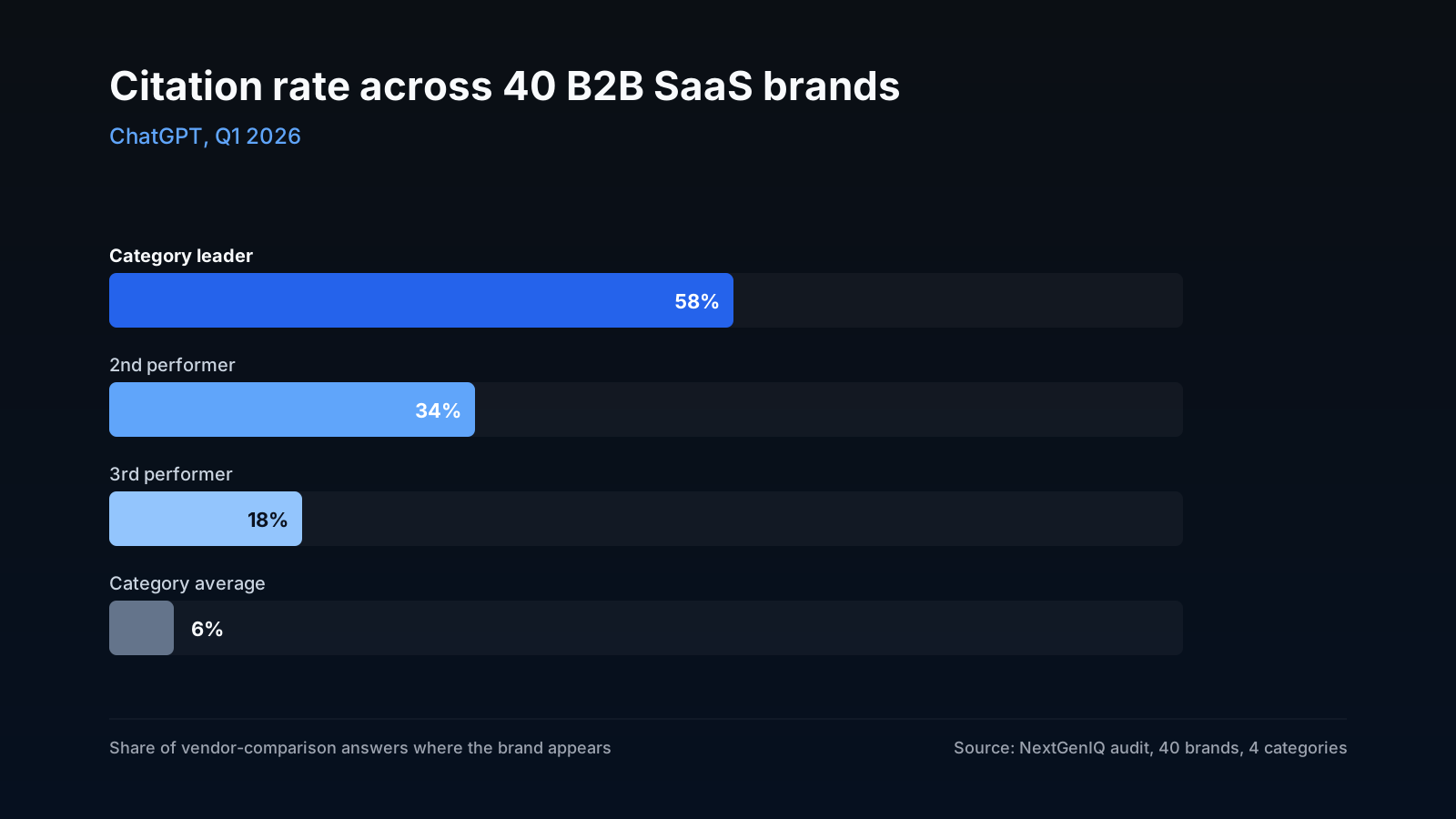
In a recent audit of 40 mid-market B2B SaaS sites across four categories, the average brand appeared in 6% of vendor-comparison answers on ChatGPT. The top performer in each category appeared in 58%.
That is a ten-times gap, and it shows up in pipeline before it shows up in traffic.
This post defines AI visibility in concrete terms, walks through why most B2B companies are invisible, and explains the four inputs that actually move the number. No generic advice. No "improve entity clarity" without telling you how.
What AI visibility actually measures
AI visibility is the share of AI-generated answers, in your category, where your brand is cited, named, linked, or recommended.
There are three distinct ways this can happen, and they matter differently:
- Cited: your URL appears as a linked source in an answer. Highest-trust signal.
- Named: your brand is mentioned in the generated text without a link. Strong signal.
- Recommended: your brand is surfaced in response to a commercial-intent prompt like "best tools for X" or "alternatives to Y". Highest-value signal.
Most "AI visibility" tools only track the first two. The third is the one tied to pipeline.
Why most B2B brands are invisible
Every NextGenIQ audit surfaces the same five patterns. If you recognize two or more, your category is quietly moving around you.
Pattern 1. Your homepage says what you do, not what you solve. AI engines summarize what your page says the brand is for. If your hero reads "The all-in-one platform for modern teams," an AI engine has nothing to associate you with. Compare that to "NextGenIQ tracks how ChatGPT, Perplexity, Gemini, and Claude recommend your brand." The second version gives the model a specific entity-to-outcome link.
Pattern 2. You have thin category content. If a buyer asks "best [your category] tools," AI engines answer from sources that have written directly about that category. If your only page on the topic is a 400-word blog, you lose to any competitor with a 2,000-word comparison piece, even if your product is better.
Pattern 3. You have no third-party validation. Most AI engines weight citation sources by perceived authority. If your brand only appears on your own domain, the model has nothing to corroborate. One podcast mention, one Reddit thread, one analyst quote, or one inclusion in a third-party listicle often moves visibility more than ten new pages on your site.
Pattern 4. Your structured data is incomplete. Missing or weak Organization, Product, and FAQ schema forces AI engines to guess at your entity. Schema is not a ranking factor in the classic SEO sense for AI answers, but it is a confidence factor. When two brands are equally qualified to be cited, the one with clean structured data wins.
Pattern 5. You are not answering commercial-intent questions directly. Most B2B content stops at awareness-stage explainers. AI engines cite content that answers the buyer's actual question: "how do I evaluate X," "which tools are best for [use case]," "what does [your category] cost." If you have no page answering those, you will not be cited for them.
The four levers that change your score
You cannot optimize for "AI visibility" as a single thing. It is a composite. These are the four inputs, ranked by how fast they move:
1. Entity clarity (fastest to change). What your homepage, about page, and product pages say you are. Rewriting a hero section for specificity can change visibility on branded queries within 2 to 3 weeks.
2. Commercial content depth. Pages answering high-intent buyer questions. Adding a single "alternatives to [competitor]" or "[category] pricing guide" page tends to start pulling citations within 4 to 8 weeks.
3. Source diversity. Mentions on third-party domains that AI engines already trust. One Substack feature or a Product Hunt launch with discussion typically moves visibility within 2 to 4 weeks. Paid listicles rarely do.
4. Structured data (slowest, but compounding). Organization schema, Product schema, and FAQ schema. Effects stack over months. Do this once, well, and stop touching it.
How to check your AI visibility today
Do not buy a tool to start. Spend 20 minutes and do this manually first:
- Open a fresh ChatGPT window (no memory, logged out).
- Ask 10 questions a real buyer in your category would ask. Mix of: category queries ("best X tools"), comparison queries ("X vs Y"), use-case queries ("X for [industry]"), and pain-point queries ("how to solve [problem]").
- For each answer, record: does your brand appear? Is it cited, named, or recommended? Who else shows up?
- Repeat on Perplexity, Gemini, and Claude.
You now have a baseline. If you appear in less than 20% of commercial-intent queries, you have a problem worth the budget to fix.
What to do if you are invisible
In order, not in parallel:
- Rewrite your homepage hero and solution pages for category clarity.
- Publish one comparison page and one "alternatives to [top competitor]" page.
- Get two third-party mentions this quarter (not paid listicles, real ones).
- Audit and complete your Organization and Product schema.
- Re-run the manual baseline in 60 days.
If you want the measurement layer automated, that is exactly what NextGenIQ tracks: citation and recommendation rates across the four major AI engines, weekly, with a diff so you can see what moved.
The bottom line
AI visibility is not a vanity metric. It is the new leading indicator for B2B pipeline in categories where buyers research before they book calls, which is most B2B categories now.
The companies that start measuring this in 2026 will have a two-year head start on the ones that wait for it to show up in their CRM.
Run a free NextGenIQ AI visibility audit to see where you stand across ChatGPT, Perplexity, Gemini, and Claude. No credit card, results in 60 seconds.
See what ChatGPT says about your brand.
NextGenIQ runs your real buyer prompts across ChatGPT, Perplexity, Gemini, and Claude. Get your AI visibility score in 60 seconds.
Check Your AI Visibility for Free